Song cupboard 1
A
basket full of nuts
A cat
came a-fiddling out of a barn
A
frog went walking on a summer’s day
A
hundred years is a very long time
A
little bird sat on a tree
Billy
Boy
Bobby
Shaftoe
Bought
me a cat
Captain
Patch the pirate
Cluck,
old hen
Don’t
drop litter
Don’t
waste water
Down
in the forest
Down
in the meadow, hop a doodle
Ducks
in the millpond
Free
little bird
Fiddle-de-dee / The Fly has married the Bumble Bee
Farmer
Brown’s cow
Go
tell Aunt Rhody
Grasshoppers
three
Honey
spread on brown, brown, bread
Ifca’s
castle
I
have a little tiny house
I saw
a ship a-sailing
I
went to the animal fair
I
went to the cabbages
Jack
the lad and Jim
Jelly
on a plate
Katie
Beardie
Last updated: 8/2/2015
1:10 PM
The songs below are part of ‘Away we
go’ Round and about
compiled, adapted and illustrated by Dany Rosevear
Return to the ‘Singing games for
children’ home
 To listen to music from these
songs click on O
To listen to music from these
songs click on O
To watch the author
sing a song click on the title at:
© Dany Rosevear 2008 All rights reserved
You
are free to copy, distribute, display and perform these works under the
following conditions:
·
you must give the original author credit
·
you may not use this work for commercial purposes
·
for any re-use or distribution, you must make clear to others the
licence terms of this work
·
any of these can be waived if you get permission from the copyright
holder
Your
fair use and other rights are no way affected by the above.
|
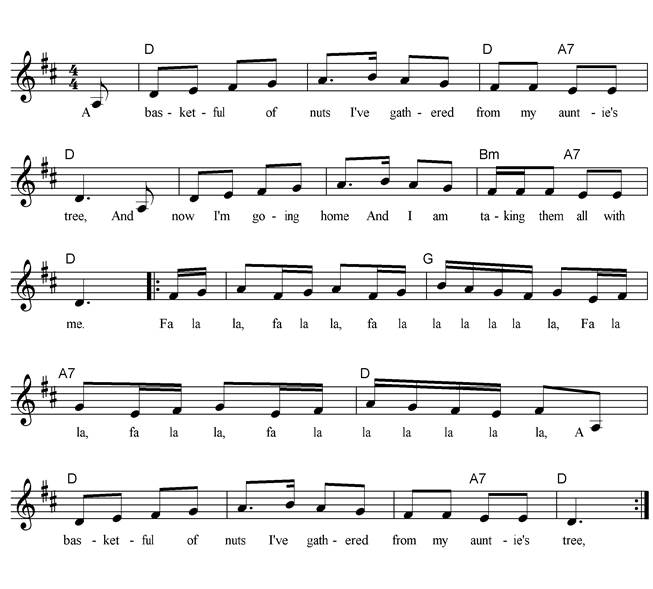
A song from the Dutch tradition. The English words are by R. Elkin and
the song comes from Mabel F. Wilson’s ‘Music time’ an infant teacher’s
classic in the 1960s. |
|
A basket full of nuts I’ve gathered from my
auntie’s tree, And now I’m going home and I am taking them all
with me. Fa la la, fa la la, fa la la la la la
la, Fa la la, fa la la, fa la la la la la
la, A basket full of nuts I’ve gathered from my
auntie’s tree. |
|
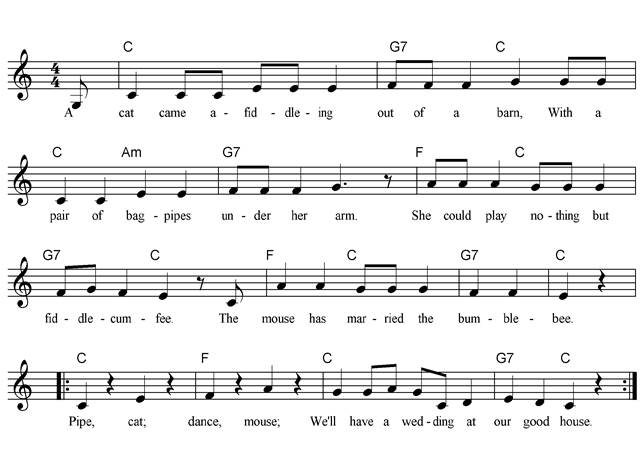
This is more traditionally
known as: ‘A cat came fiddling out of
a barn’. I came across it in The Oxford
Dictionary of Nursery Rhymes (edited by Iona and Peter Opie) where it was
noted that the earliest form of this rhyme appeared in a Wiltshire manuscript
and in Nursery Songs and London Jingles both dated around 1740. |
|
A cat came a-fiddling out
of a barn, With a pair of bagpipes
under her arm. She could play nothing but
fiddle-cum-fee, The mouse has married the
bumble bee. Pipe, cat; dance, mouse; We'll have a wedding at
our good house, Pipe, cat; dance, mouse; We'll have a wedding at
our good house, A pig came a-dancing out
of the barn, With a pair of drums
tucked under his arm. He could play nothing but
diddle-dum-dee, The mouse has married the
bumble bee. Pipe, cat; dance, mouse; We'll have a wedding at
our good house… A cow came dancing out of
the barn, With a big brass horn
under her arm. She could play nothing but
tootle-tum-tee, The mouse has married the
bumble bee. Pipe, cat; dance, mouse; We'll have a wedding at
our good house… |
|
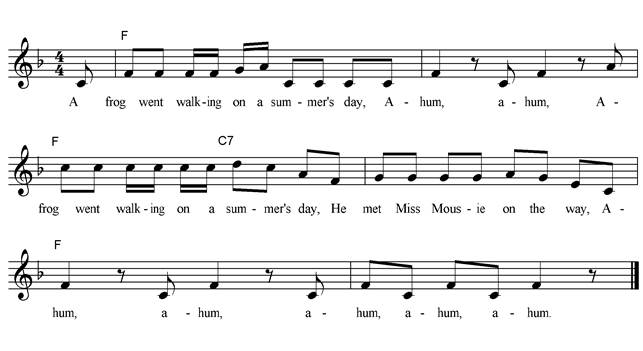
This is more traditionally known as: Frog went a-courtin’’. This version is adapted from Barbara Ireson
and Christopher Rowe’s ‘Over and over again’ published in 1978. A slightly
different song was recorded by the Wiggles in Australia. |

|
A frog went walking on a
summer’s day, A hum, a hum. A frog went walking on a
summer’s day, He met Miss Mousie on the way, A hum, a hum, a hum, a
hum, a hum. He said, “Miss Mousie will you marry me?” A hum, a hum, He said, “Miss Mousie will you marry me? We’ll live together in an
apple tree.” A hum, a hum, a hum, a
hum, a hum. The first to the wedding
was Mr. Pig, A hum, a hum, The first to the wedding
was Mr. Pig, He played the guitar and
danced a jig, A hum, a hum, a hum, a
hum, a hum. And what do you think they
had for supper? A hum, a hum, And what do you think they
had for supper? A fried mosquito and bread
and butter. Yum yum,
yum yum, yum yum, yum yum, yum yum. And what do you think they
had on the shelf? A hum, a hum, And what do you think they
had on the shelf? If you want to know go
look for yourself. A hum, a hum, a hum, a
hum, a hum. |
|
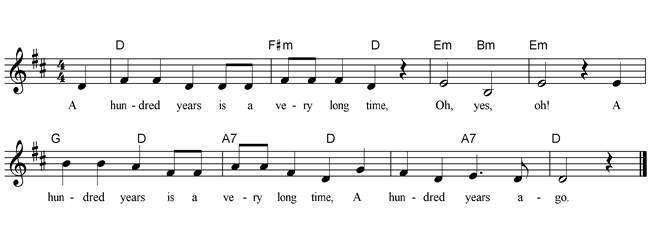
A hundred years is a very long time O
A sea shanty to be believed – do try! A hundred years is a very long
time – so true if you are young; if you are old it is no time at all! |
|
A hundred years is a very long time, Oh, yes, oh, A hundred years is a very long time, A hundred years ago. They used to think that pigs could fly, Oh, yes, oh, I don't believe it no, not I, A hundred years ago. They thought the moon was made of cheese, Oh, yes, oh, You can believe it, if you please, A hundred years ago. They thought the stars was set alight, Oh, yes, oh, By some good angel every night, A hundred years ago. A hundred years is a very long time, Oh, yes, oh, A hundred years is a very long time, A hundred years ago. I thought I heard the old man say, Oh, yes, oh, That we were homeward bound today, It's time for us to go! |
|
A German song translated into English by Mabel F. Wilson from ‘Music
time’ a infant teacher’s classic music book in the
1960s. 1, Open and close thumb and
forefinger. 2. Move fore finger like a
worm. Make hands fly. 3. Brush cheeks for cat’s
whiskers. 4. Hold up hands in
crouching position. Count with fingers to three. 5. Clap hands. 6. Make hands fly, hold
hands to chest. |
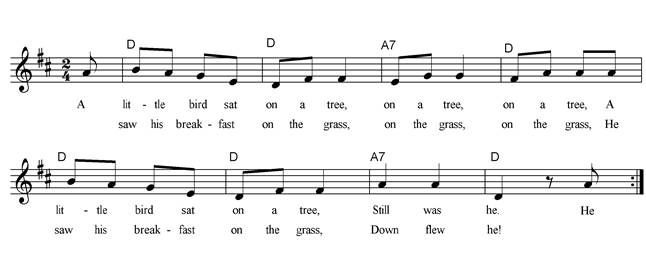
A little bird sat on a tree,
on a tree, on a tree,
A little bird sat on a tree:
Still was he.
He saw his breakfast on the
grass, on the grass, on the grass
He saw his breakfast on the
grass:
Down flew he!
A pussy cat was hiding
there, hiding there, hiding there,
A pussy cat was hiding there
Near the tree.
He set himself to make a spring,
make a spring, make a spring,
He set himself to make a
spring:
One! Two! Three!
But we began to clap our
hands, clap our hands, clap our hands,
But we began to clap our
hands
Noisily!
So then our little bird flew
off, bird flew off, bird flew off,
So then our little bird flew
off:
Glad
were we.
|
I have had fun trying to recall this song I sang at a Norfolk school in
the 1950s not so successfully. This is more or less as I remember it and put
together with a little help from the internet! It has a Roud number 326. |
|
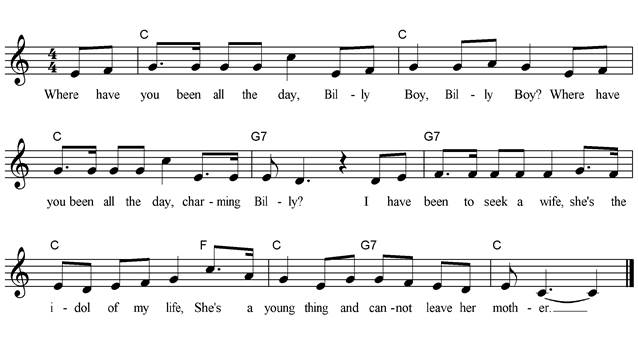
Where have you been all the day, Billy Boy, Billy
Boy? Where have you been all the day, charming Billy? I have been to seek a wife, she’s the idol of my
life, She's a young thing and cannot leave her mother. Did she ask you to come in, Billy Boy, Billy Boy?
Did she ask you to come in, charming Billy? Yes, she asked me to come in, there's a dimple on
her chin. She's a young thing and cannot leave her mother. Can she make a cherry pie… She can make a cherry pie in the twinkling of an
eye… Can she sew and can she spin… She can sew and she can spin, she can do most
anything… Can she make a feather bed… She can make a feather bed with the feet up at the
head… How old is she, Billy Boy, Billy Boy? How old is she, charming Billy? Three times six and four times seven, Twenty-eight and eleven, She's a young thing and cannot leave her mother. |
|
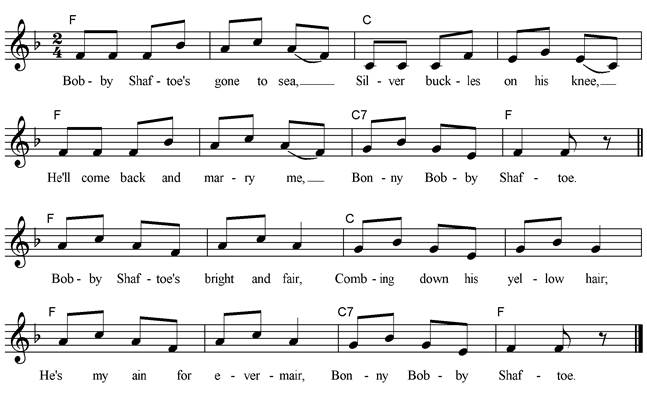
A song with a delightfully
jolly and bouncy tune, Bobby Shaftoe was a handsome
fellow who broke the heart of a lady. He was also a parliamentarian from
County Durham. Find out more at: http://en.wikipedia.org/wiki/Bobby_Shafto's_Gone_to_Sea
Bobby
Shaftoe's gone to sea, Silver
buckles on his knee; He'll
come back and marry me, Bonny
Bobby Shaftoe! Bobby
Shaftoe's bright and fair, Combing
down his yellow hair; He’s
my ain for evermair, Bonny
Bobby Shaftoe! Bobby
Shafto's getten a bairn, For
to dangle on his arm; In
his arm and on his knee, Bobby
Shafto loves me.[ Bobby
Shaftoe's been to sea, Silver
buckles on his knee; He's
come back to marry me, Bonny
Bobby Shaftoe! |
|
A classic American
children’s folk song. Use puppets to help children
remember the order of each farm animal. For even more fun allocate animal
masks, they can make their own, to a group of children who stand up from
squatting each time their animal is named.
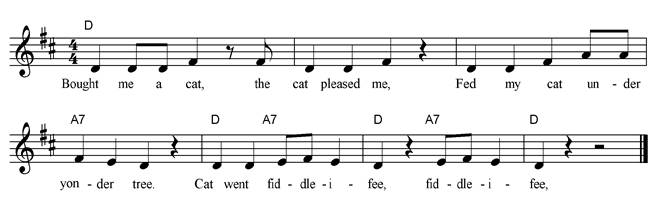
Bought me a cat, the cat
pleased me, Fed my cat under yonder
tree. Cat went fiddle-i-fee, fiddle-i-fee. Bought me a hen, the hen
pleased me, Fed my hen under yonder
tree. Hen went chipsy-chopsy, Cat went fiddle-i-fee, fiddle-i-fee. Bought me a duck, the duck
pleased me, Fed my duck under yonder
tree. Duck went slishy, sloshy, Hen went chipsy-chopsy, Cat went fiddle-i-fee, fiddle-i-fee. Bought me a goose, the
goose pleased me, Fed my goose under yonder
tree. Goose went quaa, Duck went slishy, sloshy, Hen went chipsy-chopsy, Cat went fiddle-i-fee, fiddle-i-fee. Bought me a sheep... Sheep
went baa... Bought me a cow... Cow
went moo... Bought me a horse ...
Horse went neigh... Bought me a baby... Baby
went whaa.. Bought me a wife... Wife
went honey, honey ... |
|
A song from
the BBC-TV Watch programme; words by Tom Stanier,
music by Elizabeth Bennett. It also appears in ‘Knock at the Door’ by Jan
Betts 1980 Ward Lock Educational. |
|
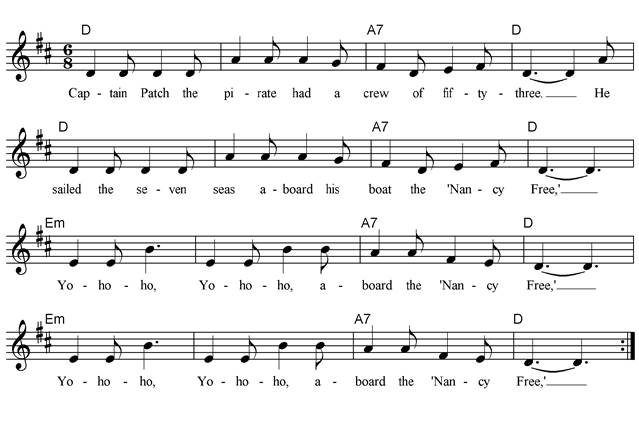
Captain Patch the pirate had a crew of fifty three. He sailed the seven seas aboard his boat the ‘Nancy Free’ Yo-ho-ho, Yo-ho-ho, aboard the ‘Nancy Free’. X2 Many
merchant ships he found, and many ships he sank. And those
who met the Nancy Free were made to walk the plank. Splish,
splash, splosh, splish, splash, splosh, were made to walk the plank. X2 Captain Patch was awful fierce and so were all his crew. But they kept leaving things behind and that you mustn’t
do. Yo-ho-ho, Yo-ho-ho, and that you mustn’t do. X2 One
day they leapt aboard an English ship of forty tons. And
they were so forgetful they forgot to bring their guns Yo-ho-ho, Yo-ho-ho, forgot to bring their guns. X2 The English captain jumped for joy: ‘Arrest those men’ said
he. We’ve captured Captain Patch and all his crew of fifty
three. Yo-ho-ho, Yo-ho-ho, his crew of fifty three. X2 ‘What a silly blunder for such pirates bold to make. Now we’ll make them walk the plank to pay for their
mistake.’ Splish,
splash, splosh, splish, splash, splosh, to pay for their mistake. X2 That’s
the end of Captain Patch and all his
pirate larks. His end delighted everyone, including lots of sharks. Yo-ho-ho, Yo-ho-ho, including lots of sharks. X2 |
|
A great favourite for banjo claw hammering. This version comes from
Alex Usher’s ‘Children’s song favourites’. You can find many more versions
at: http://mudcat.org/thread.cfm?threadid=61809 |
|
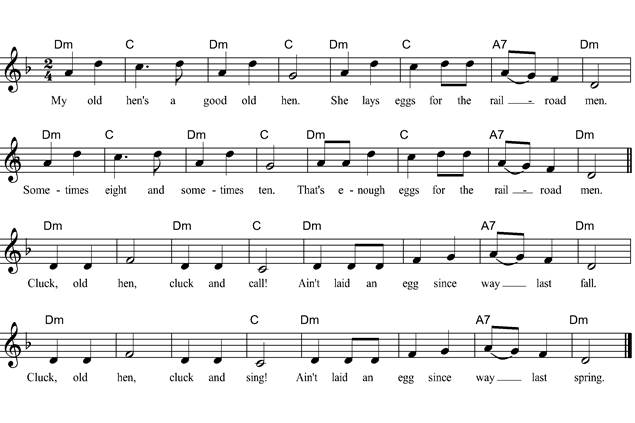
My old hen's a good old hen, She lays eggs for the railroad men. Sometimes eight, and sometimes ten; That's enough eggs for the railroad men. Chorus Cluck, old hen, cluck and call! Ain't laid an egg since way last fall. Cluck, old hen, cluck and sing! Ain't laid an egg since way last spring. Cluck, old hen, cluck a lot, If you don’t cluck, you’ll be put in a pot! Cluck, old hen, cluck I say, Cluck, old hen, or I’ll give you away. Chorus My old hen is fine and true, She lays eggs and 'taters too, Sometimes an onion, one or two… Then jumps in the pot for a chicken stew! |
|
Tom Farmer has fallen asleep and allowed the farm animals into the
house – he needs to be woken up! (It is a good idea to place hands round the
mouth when shouting to protect children’s ears!) Children can have great fun making up other alliterative lines for
more farmyard animals. |

|
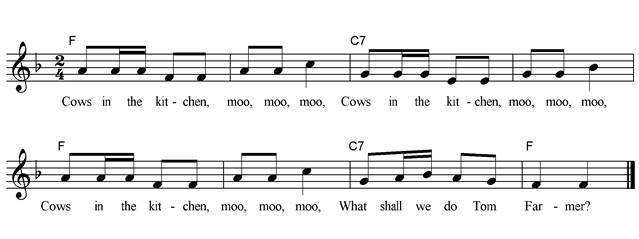
Cows in the kitchen, moo,
moo, moo, Cows in the kitchen, moo, moo,
moo, Cows in the kitchen, moo,
moo, moo, What shall we do Tom
Farmer? Ducks in the dustbin, quackerdy doo, Ducks in the dustbin, quackerdy doo, Ducks in the dustbin, quackerdy doo, What shall we do Tom
Farmer? Cats in the cupboard,
doggies too, Cats in the cupboard,
doggies too, Cats in the cupboard,
doggies too, What shall we do Tom
Farmer? Pigs in the pantry, oink,
oink, oink, Pigs in the pantry, oink,
oink, oink, Pigs in the pantry, oink,
oink, oink, What shall we do Tom
Farmer? Tom Farmer in the haystack
fast asleep, Tom Farmer in the haystack
fast asleep, Tom Farmer in the haystack
fast asleep, (SHOUT) Time to wake up
Tom Farmer! Chase them away with a
shoo, shoo, shoo, Chase them away with a
shoo, shoo, shoo, Chase them away with a
shoo, shoo, shoo, That's what we'll do Tom
Farmer. |
|
Start early learning how to contribute to a world free from rubbish. This song is sung to the tune of ‘Ten green bottle’. |
|
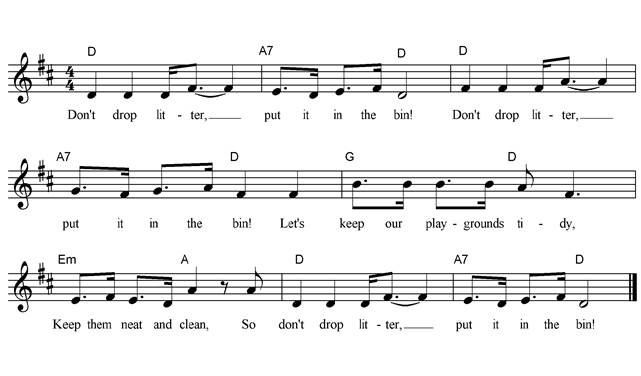
Don’t drop litter, put it
in the bin, Don’t drop litter, put it
in the bin, Let’s keep our playgrounds
tidy, Keep them neat and clean, So don’t drop litter, put
it in the bin! No crisp packets, put them
in the bin! No sweet wrappers, put
them in the bin! Let’s keep the streets
around us Tidy, neat and clean, So don’t drop litter, put
it in the bin! No plastic rubbish, put it
in the bin! No cans and bottles, put them
in the bin! Keep parks and woodlands
tidy, Keep them neat and green, So don’t drop litter, put
it in the bin! Please recycle plastic,
paper, tin, Please recycle, put it in
a bin, Let’s keep our planet
tidy, Keep it clean and green, So please recycle, put it
in a bin! |
|
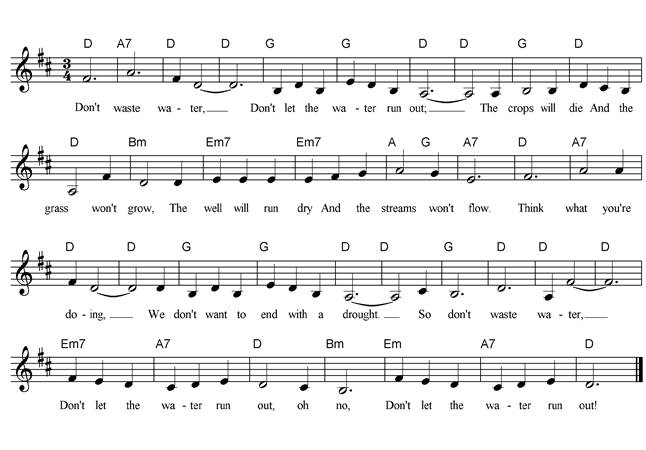
Words and music by Kate Umansky. We all need to think about the conservation of this precious
commodity. |
|
Don’t waste water, Don’t let the water run
out; The crops will die and the
grass won’t grow, The well will run dry And the streams won’t
flow. Think what you’re doing, We don’t want to end with
a drought. So don’t waste water , Don’t let the water run
out, oh no, Don’t let the water run
out! |
|
Down in the forest O
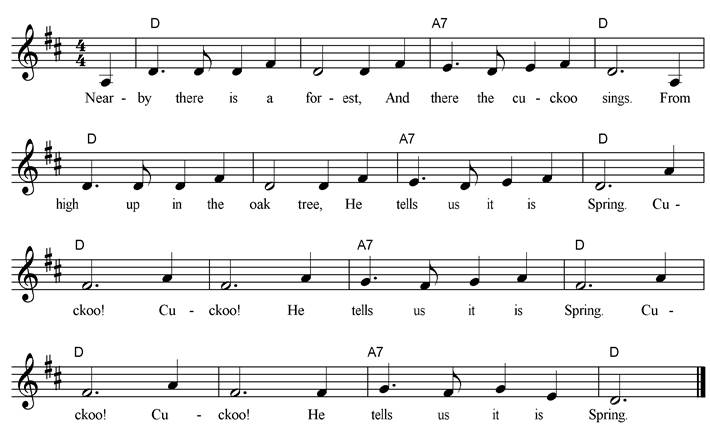
This is a short version of the French song ‘Dans la forêt lointaine’ and can be found in its original language at: http://singinggamesforchildren.com/A%20Cluster%202.4%20Allonsy/31to43%20Jouons%20tous%20ensemble.htm.
It is also translated as ‘Down in yonder forest’. Enjoy making bird noises. It can be sung as a round. |
|
Nearby there is a forest, And there the cuckoo
sings. From high up in the oak
tree, He tells us it is Spring. Cuckoo! Cuckoo! He tells us it is Spring. Cuckoo! Cuckoo! He tells us it is Spring. Far off in yonder forest, An owl is out of sight. From high up in the oak
tree, He tells us it is night. Hoo-oo! Hoo-oo! He tells us it is night. Hoo-oo! Hoo-oo! He tells us it is night. |
|
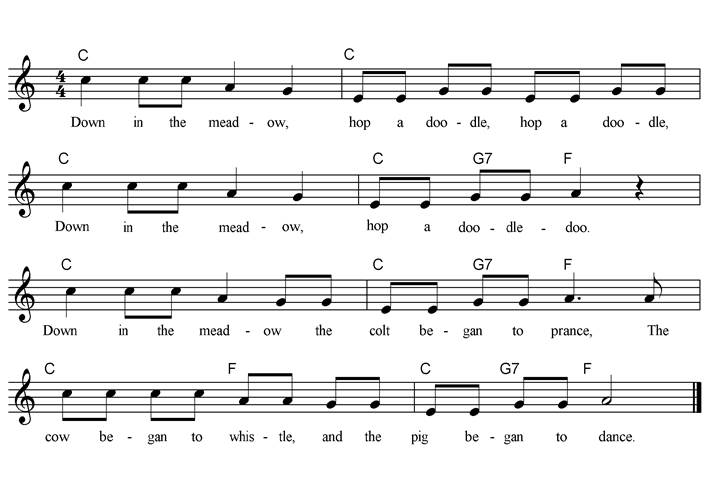
A song with a regular beat. Children will enjoy tapping to the pulse
or hopping in time to the music. |
|
Down in the meadow, hop a
doodle, hop a doodle, Down in the meadow, hop a
doodle doo! Down in the meadow the
horse began to prance, The cow began to whistle
and the pig began to dance. Down in the barnyard, hop a doodle, hop a doodle, Down in the barnyard, hop a doodle doo! Down in the barnyard the goose began to sing, The
hen began to cackle, as the rooster flapped a wing. Hop a doodle, hop a
doodle, Hop a doodle doo, Hop a doodle, hop a
doodle, Hop a doodle doo! |
|
A song from Virginia USA. |

|
Ducks in the millpond,
geese in the clover, Fell in the millpond,
got wet all over. Lawd, Lawd, gonna get on a rinktum, Lawd, Lawd, gonna get on a rinktum. Ducks in the millpond,
geese in the clover, Jumped in the bed, And
the bed turned over. Monkey in the barnyard,
a-monkey in the stable, Monkey get your haircut
as soon as you are able. Rain come and wet me,
sun come and dry me, Step back pretty girl,
don't come a-nigh me. |
|
Farmer
Brown’s cow O
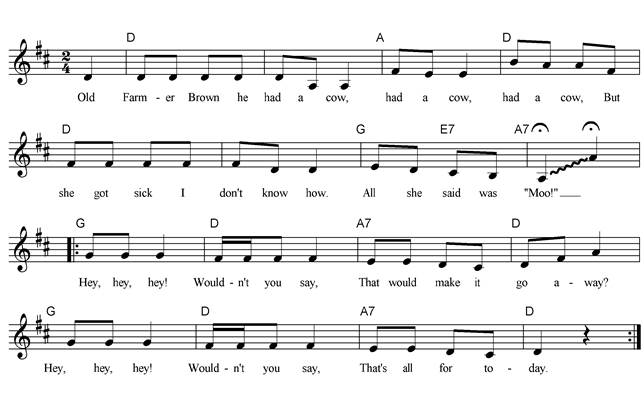
This Belgian folk song could support a discussion about healthy
eating. There are a lot more verses to be found online or you could make up
your own. This could also be played as
a circle game standing next to a partner. Bend knees up and down for each of
the verses; then link arms with partner and skip round first one way and then
the other. |
|
Old Farmer Brown he had a
cow, had a cow, had a cow, But she got sick, I don't
know how. All she said was Moo-oo. Chorus: Hey, hey, hey! Wouldn't
you say, That would make it go
away? Hey, hey, hey! Wouldn't
you say, That's all for today. HEY! Her friend, the pig
brought chocolate cake, chocolate cake, chocolate cake, To see if that would help
her ache. But all she said was “Moo!” The little duck brought
gingerbread, gingerbread, gingerbread, To see if that would clear
her head. But all she said was
“Moo!” The farmer's dog brought
cherry tart, cherry tart, cherry tart, To ease the pain above her
heart. But all she said was “Moo!” The old black sheep
brought ham and eggs, ham and eggs, ham and eggs, To help her stand upon her
legs. But all she said was
“Moo!” The farmer brought a load
of grain, load of grain, load of grain, And then she didn't have a
pain. All she said was “Moo!” Now you may want to sing
some more, sing some more, sing some more, But now her throat is
feeling sore Cause all she said was
“Moo!” |
|
Once familiar as ‘The fly has married the humble bee’; this version is
from New England. Crane’s ‘Baby’s Bouquet’ 1897 had a similar version. The Opie’s suggest that the ‘The cat came a fiddling out of the barn’
and this song were once sung together. |

|
Fiddle-de-dee,
Fiddle-de-dee, The Fly has married the
Bumble Bee, Says the Fly, says he,
"Will you marry me? And live with me, sweet
Bumble Bee?" Fiddle-de-dee,
Fiddle-de-dee, The Fly has married the
Bumble Bee. Fiddle-de-dee,
Fiddle-de-dee, The Fly has married the
Bumble Bee, Says the Bee, says she,
"I'll live under your wing, And you'll never know I carry
a sting." Fiddle-de-dee,
Fiddle-de-dee, The Fly has married the
Bumble Bee. Fiddle-de-dee,
Fiddle-de-dee, The Fly has married the
Bumble Bee, So when Parson Beetle had
joined the pair, They both took off to take to
the air. Fiddle-de-dee,
Fiddle-de-dee, The Fly has married the
Bumble Bee. Fiddle-de-dee,
Fiddle-de-dee, The Fly has married the
Bumble Bee, And the bees did buzz and the
bells did ring, Did ever you hear a merrier
thing! Fiddle-de-dee,
Fiddle-de-dee, The Fly has married the
Bumble Bee. |
|
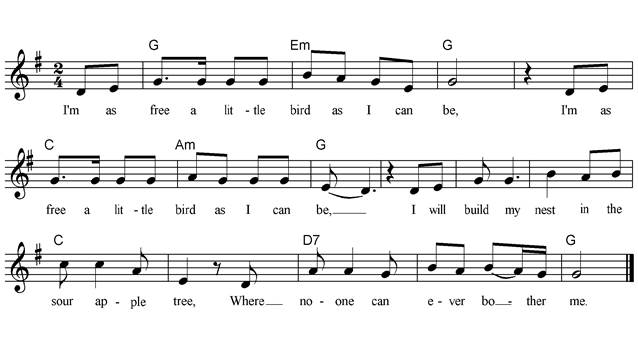
I came across this song in ‘American folk songs for children’ by Ruth Crawford Seeger published
by Doubleday, 1948. ’Where those bad boys will’ has been changed
to ‘Where no-one can’ which is found in other more recent renderings of this
song. |
|
I'm as free a little bird
as I can be, I'm as free a little bird
as I can be, I'll build my nest in the
sour apple tree, Where no-one can ever
bother me. Oh, who will shoe your
little foot, And who will glove your
little hand, And who will kiss your
sweet rosy cheeks When I'm gone to that far
distant land? Oh, it's mama will shoe my
little foot, And it's papa will glove
my little hand, And it's you shall kiss my
sweet rosy cheeks When you come from that
far distant land. Take me home, little
birdie, take me home, Take me home by the light
of the moon, With the moon a-shining bright
and the stars a-giving light Take me home to my mama,
take me home. |
|
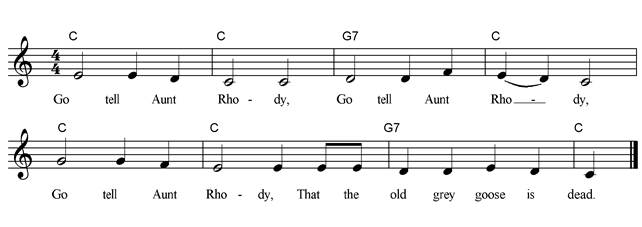
A traditional made well known by Pete Seeger A popular choice in
schools in the 1960 and was. Find out more about this sad tale at: http://www.balladofamerica.com/music/indexes/songs/gotellauntrhody/index.htm |
|
Go tell Aunt Rhody, Go tell Aunt Rhody, Go tell Aunt Rhody The old grey goose is dead. The one she's been saving, The one she's been saving, The one she's been saving To make a feather bed. She died in the mill pond, She died in the mill pond, She died in the mill pond Standing on her head. The goslings are crying, The goslings are crying, The goslings are crying Because their mammy's dead. The old gander’s weeping, The old gander’s weeping, The old gander’s weeping, Because his wife is dead. Go tell Aunt Rhody, Go tell Aunt Rhody, Go tell Aunt Rhody The old grey goose is dead. |
|
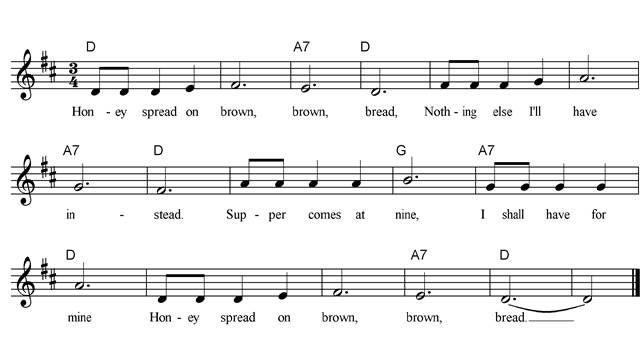
Honey spread on brown, brown bread O Mmmmm! I believe this is a Czech song. The words are by Edith M Clark; I wrote the middle verse. |

|
Honey spread on brown, brown,
bread. Nothing else I'll have
instead. Supper comes at nine, I shall have for mine Honey spread on brown, brown
bread. All the little bees, it’s
said, Pollinate the flowerbeds, And when they get back home, Fill their honeycombs With honey for my brown,
brown bread. How do all those tiny bees, Make their honey with such
ease? They make lots and lots, To fill so many pots With honey for my brown,
brown bread. When I'm led away to bed, Beneath my counterpane of red I shall dream of bees And of yellow seas, Honey spread on brown, brown
bread. |
|
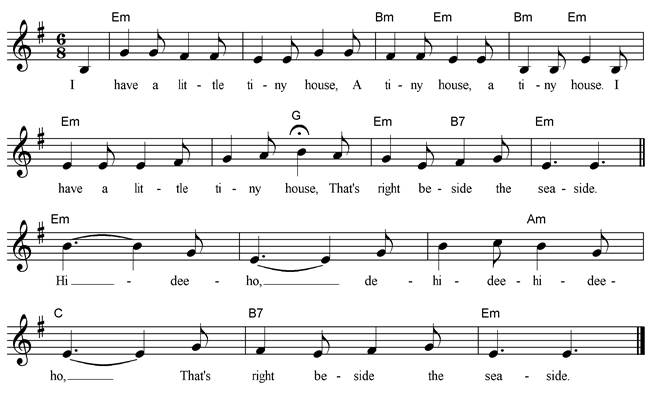
This is from the traditional Welsh song ‘ Tŷ Bach Twt’ ‘The
tidy little house’ You can find the Welsh version at: http://www.mamalisa.com/?lang=Welsh&t=es&p=2547#multimediaBoxInternalLink The words here are a delightful take by Mari Griffiths and originally
came from the BBC radio Music Box programme. |
|
I have a little tiny house, A tiny house, a tiny house. I have a little tiny house, That’s
right beside the seaside. Hi-dee-ho, de-hi-dee-hi-dee-ho, That’s
right beside the seaside. I
do no work, I sit and watch, I
sit and watch, I sit and watch. I
do no work, I sit and watch, The
high tide and the low tide. Hi-dee-ho, de-hi-dee-hi-dee-ho, The
high tide and the low tide. And
here I live and eat and sleep, And
eat and sleep, and eat and sleep; And
here I live and eat and sleep, Contented
by the fireside. Hi-dee-ho, de-hi-dee-hi-dee-ho, Contented
by the fireside. |
|
Iona and Peter Opie say in
their’ Oxford Dictionary of Nursery Rhymes’ that the lines below were copied with
some variation into a family album of verse, dated 1815,by a Mrs Elizabeth
Susannah Graham. A version with ‘raisins in
the cabin, And almonds in the hold ‘is from ’Ye fairy ship’ by Walter Crane
and the tune below with slight changes
comes from ‘The Baby's
Bouquet, A Fresh Bunch of Rhymes and Tunes’ by Walter Crane (1878). I am more familiar with the words below. A
correspondent for the Revue Celtique, 1880, saw
children singing it as they danced in a circle imitating ducks. |


|
I saw a ship a-sailing, A-sailing on the sea; And oh, but it was laden, With pretty things for me! There were comfits in the cabin, And apples in the hold; The sails were made of satin, And the masts were made of gold. The four-and-twenty sailors That stood between the decks, Were four-and-twenty white mice With chains about their necks. The captain was a duck, a duck, With a packet on his back; And when the ship began to move, The captain said, "Quack! Quack! " |
|
Have fun with the sound effects in this song using the voice or
percussion.. Sung by American sailors as early as 1898; the words were more
appropriate to a seafaring life ‘The
monkey he got drunk’ More modern versions end
with: ‘And that was the end of the monkey...’ It was also popular as an American minstrel song where ‘the monk, the
monk, the monk, the monk...’ was sung ad infinitum. |

|
I went to the animal fair, The birds and the beasts were there, The big baboon by the light of the moon Was combing his auburn hair. The monkey fell out of his bunk, Bump! And slid down the elephant's trunk, Wheee! The elephant sneezed, Atchoo! And fell on his knees, Oh dear! And what became of the monkey, monkey, monkey,
monkey, And what became of the monk? |
|
A song about the caterpillar life cycle by Tom Stanier
and Liz Bennett from BBC TV’s Watch. |


|
I went to the cabbages one
day, What do you think I saw? Eggs in a cluster, yellow
as a duster, What could it all be for? I went to the cabbages one
day, What do you think I saw? Caterpillars crunching,
caterpillars munching, What could it all be for? I went to the cabbages one
day, What do you think I saw? I saw a soopa doopa pupa, What could it all be for? I went to the cabbages one
day, What do you think I saw? I saw a butterfly, watched
it flutter by; What could it all be for? I went to the cabbages one
day, What do you think I saw? Eggs in a cluster, yellow
as a duster, What could it all be for? |
|
A nautical song from BBC television’s Music Time. First published in
1983. |

|
There were two pirates
went to sea, Jack the lad and Jim. The terrors of the Barbary, Jack the lad and Jim. Gold
and silver they did plunder, Jack the lad and Jim. They raised the flag and
cried, ‘Hooray!’ Jack the lad and Jim. Then Jack says, ‘Jim we’ve lost our way’. Jack the lad and Jim. Run
aground, on rocks they foundered, Jack the lad and Jim. And then one day a ship
they spied, Jack the lad and Jim. A-sailing westward on the tide, Jack the lad and Jim. ‘Ship
ahoy!’ they called, so joyous, Jack the lad and Jim. The ship drew near with
all her crew, Jack the lad and Jim. And then they saw the flag she flew, Jack the lad and Jim. Pirates
all, oh what misfortune, Jack the lad and Jim. Then fifty pirates came
aboard, Jack the lad and Jim. And stole their gold and silver hoard, Jack the lad and Jim. Cried
‘Hooray!’ and sailed away from, Jack the lad and Jim. |
|
Get moving to this wibbly wobbly song.
|

|
A great song for making up
your own rhymes. This is an anglicized
version of the Scottish nursery rhyme. If you would like to try it in
dialects go to: http://www.traditionalmusic.co.uk/folk-song-lyrics/Katie_Beardie.htm . You can also find a skipping
/ ball against the wall version online: http://www.glesga.ukpals.com/memorylanesongs.htm
|


Return to the ‘Singing games for
children’ home