Just
nursery rhymes 2
Jack
and Jill
Ladybird,
ladybird
Little
Bo Peep
Little
Boy Blue
Little
Jack Horner
Little
King Pippin
Little
Miss Muffet
Mary
had a little lamb
Mary,
Mary quite contrary
Old
King Cole
Old
Mother Hubbard
On
Saturday night I lost my wife
Pease
pudding hot
Polly
put the kettle on
The
lion and the unicorn
There
was a crooked man
There
was an old woman lived under the stairs
There
was an old woman tossed up in a basket
This
is the House that Jack built
Three
men in a tub
Tom,
he was a piper’s son
Wee
Willie Winkie
Last updated: 3/23/2016
4:20 PM
These
songs are nursery rhymes and other traditional songs compiled, illustrated and
music arranged by Dany Rosevear.
Return to the ‘Singing games for children’ home
page
 To listen to music from these
songs click on O
To listen to music from these
songs click on O
To watch the
author sing a song click on the title at:
© Dany Rosevear 2013 All rights reserved
You
are free to copy, distribute, display and perform these works under the following
conditions:
·
you must give the original author credit
·
you may not use this work for commercial purposes
·
for any re-use or distribution, you must make clear to others the
licence terms of this work
·
any of these can be waived if you get permission from the copyright
holder
Your
fair use and other rights are no way affected by the above.
|
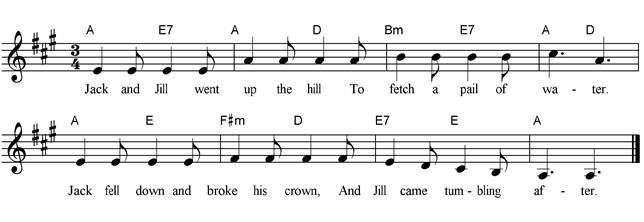
Jack and Jill O This rhyme was first
published in 1795 but is a lot older than that. To find out more about this
rhyme visit: http://en.wikipedia.org/wiki/Jack_and_Jill_(nursery_rhyme)
|
|
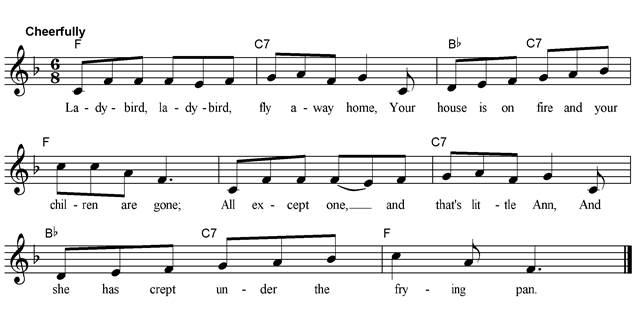
We sang this
verse as children whenever a ladybird landed on us; blowing it away gently
while singing this nursery rhyme. Sung as
‘Ladybug, ladybug’ in the US. Find out more
at: http://en.wikipedia.org/wiki/Ladybird_Ladybird:
http://www.grammarphobia.com/blog/2010/04/1697.html |
|
Ladybird,
ladybird fly away home, Your house
is on fire and your children are gone, All except
one, and that’s little Ann, And she
crept under the frying pan. Ladybird,
ladybird fly away home, Your house
is on fire and your children are gone, All except
Nan who sits in a pan, Weaving her
laces as fast as she can. |
|
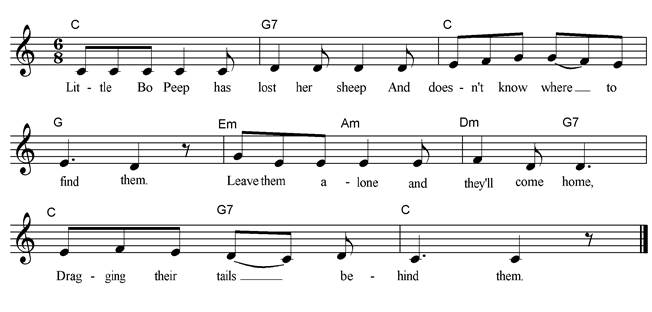
Little Bo Peep O Roud index number
6487. To find out more about this rhyme visit: http://en.wikipedia.org/wiki/Little_Bo_Peep There are many variations of these verses including
John Kirkpatricks last verse: She heaved a
sigh and wiped her eye And ran over
hill and dale-o And tried what
she could as a shepherdess should To tack to each
sheep its tail-o.
|
|
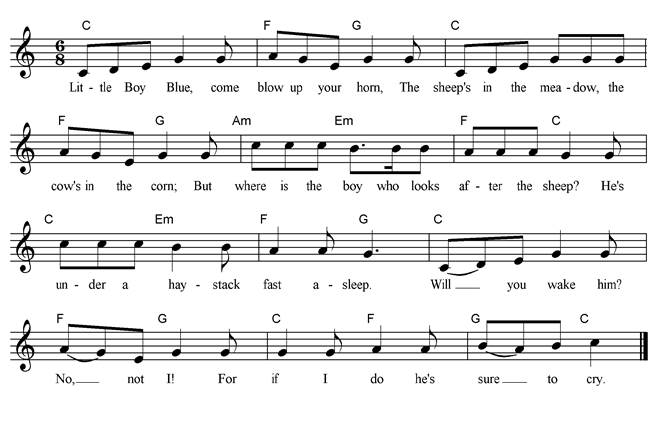
Little Boy Blue O A nursery rhyme from a more
agrarian era. It has a Roud number of 11318 To find out more about this rhyme visit: http://en.wikipedia.org/wiki/Little_Boy_Blue
|
|
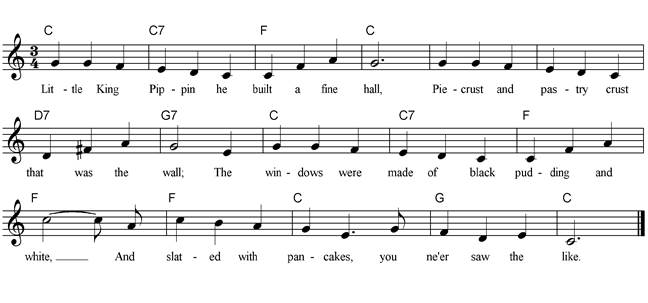
Little King Pippin O
There have traditionally been
buildings made of good things to eat in stories and rhymes of yore; Hansel
and Gretel immediately comes to mind. King Pippin was an early French
king and the father of Charlemagne, who founded the idea of a united
political Europe. He was already a familiar as a nursery character in the 18th
century. More information can be found in the Opie’s ‘Oxford dictionary of
Nursery rhymes’. |

|
Little
King Pippin he built a fine hall, Pie-crust
and pastry-crust that was the wall; The
windows were made of black pudding and white, And
slated with pancakes, you ne’er saw the like. |
|
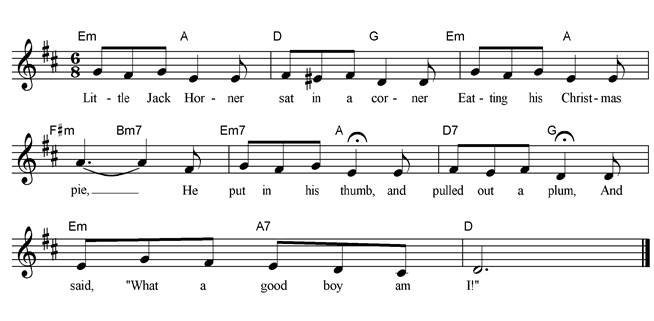
The steward of the last
abbot of Glastnbury in the time of HenryVIII supposedly pulled out some plums from a pie
being taken to the King. To find out more about this rhyme visit: http://en.wikipedia.org/wiki/Little_Jack_Horner
It has a Roud index number
of 13027. You will notice the tune is almost identical to the
one below.
|
|
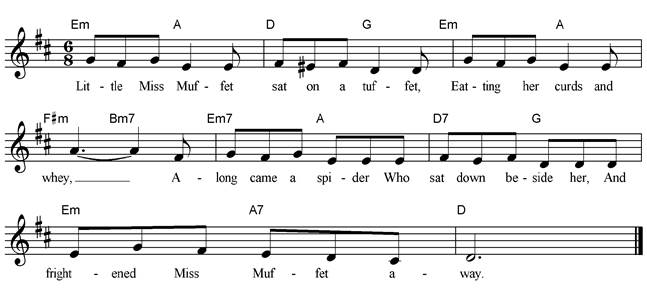
Little Miss Muffet O If you are not too keen on
spiders the second verse might make you feel more positive towards them. Have
a go at making curds and whey with full fat milk. This rhyme possibly had
political origins like many nursery rhymes. It has a Roud index number of 20605. To find out more about this rhyme visit: http://en.wikipedia.org/wiki/Little_Miss_Muffet
|
|
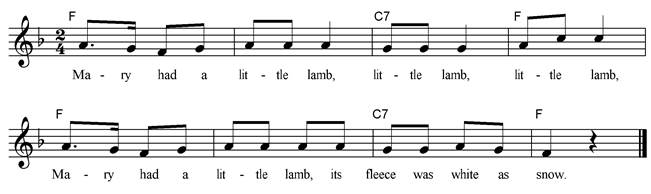
This rhyme was written by
Sarah Josepha Hale of Boston in 1830. Also wonderful to know was that Thomas
Edison recorded this on his phonograph. To find out more about this
rhyme visit: http://en.wikipedia.org/wiki/Mary_Had_a_Little_Lamb
|
|
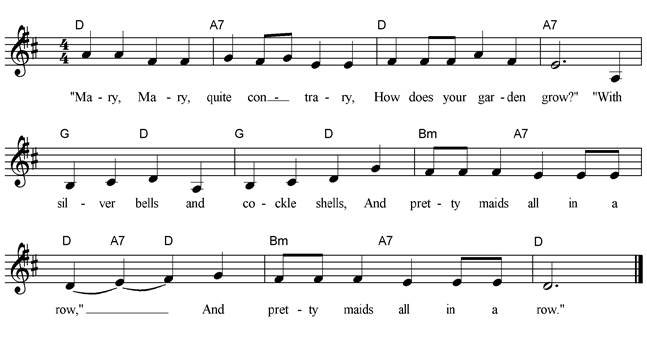
‘Mary’ possibly relates to
Mary Tudor daughter of Henry VIII or Queen Mary with the maids as her
ladies-in-waiting. It has a Roud number 19626. To find out more about this
rhyme and its historical context visit: http://www.rhymes.org.uk/mary_mary_quite_contrary.htm
|

|
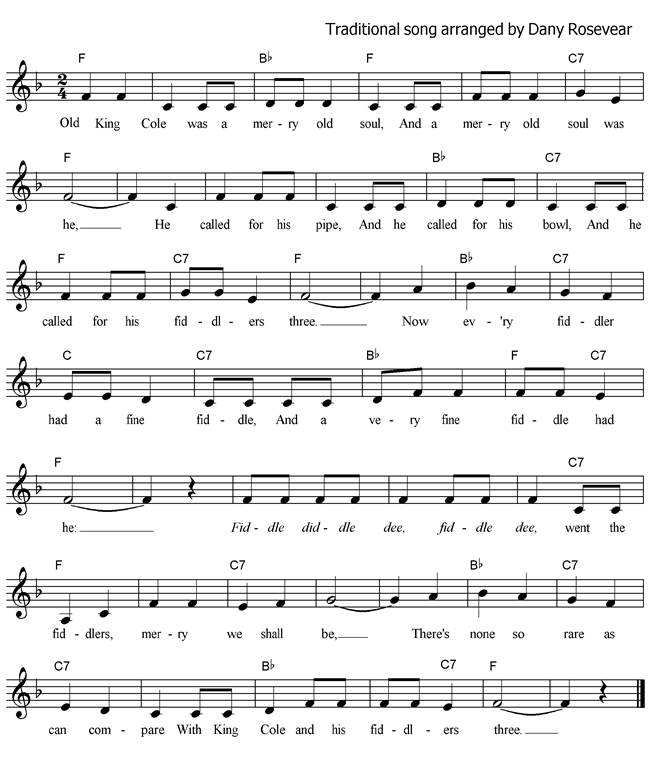
There are many variations on
this song, many quite bawdy and not suitable for young children! The tunes
also differ; many of the ones I found during my research were in the minor
key and rather lovely but I was unsuccessful finding the tune I knew from my childhood
on the internet so have made my own arrangement. The Roud number is 1164. You
can find more about this songs origins at: http://www.powerfulwords.info/nursery_rhymes/old_king_cole.htm
and also at: http://jloughnan.tripod.com/kingcole.htm
. Continue this song by making new verses to include
other instruments. Each time a new verse is sung add a line from the previous
verse. Mime playing each instrument.
|
|
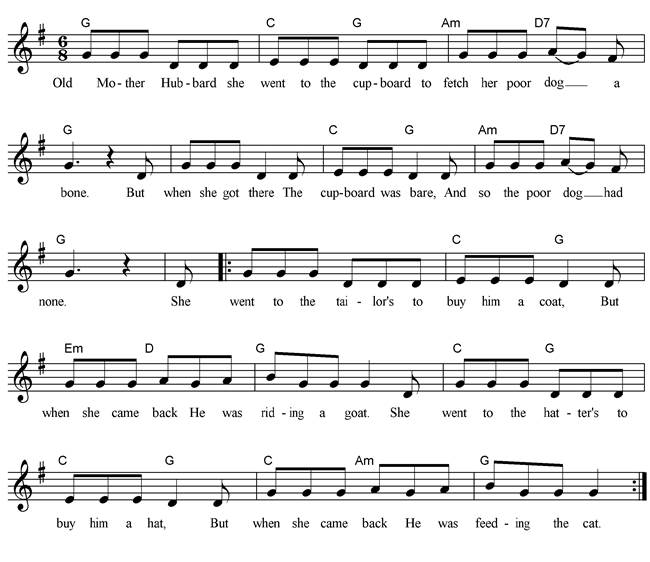
First published in 1805 this
nursery rhyme is thought to have much older origins and possibly of a
political nature linked to Cardinal Wolsey. Find out more at: http://en.wikipedia.org/wiki/Old_Mother_Hubbard
It has the Roud number19334.
|
|
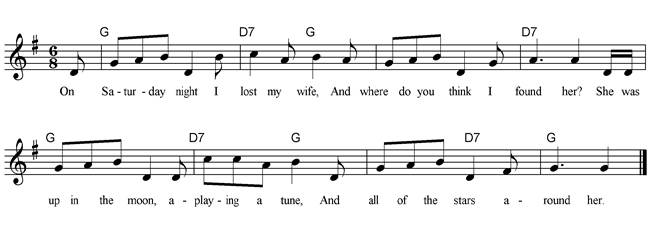
On Saturday night, I lost my wife O
A Mother Goose rhyme sung in the British
Isles and Ireland where we have a common heritage of nursery songs; perhaps
as a result of immigration from Eire. |
|
On
Saturday night, I lost my wife, And
where do you think I found her? She
was up in the moon, a-playing a tune, And
all of the stars around her. |
|
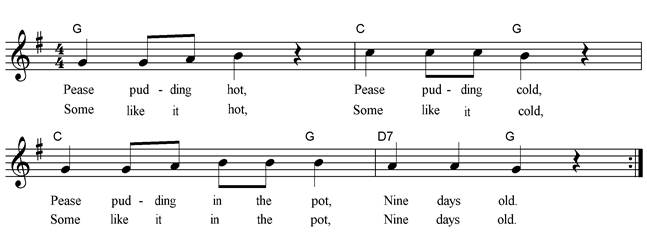
Pease pudding hot O A clapping game. In North
America it is more familiar as ‘Pease porridge’ and has a different tune. It has the Roud number 19631 To find out more about its
origins visit: http://en.wikipedia.org/wiki/Pease_Porridge_Hot
|
|
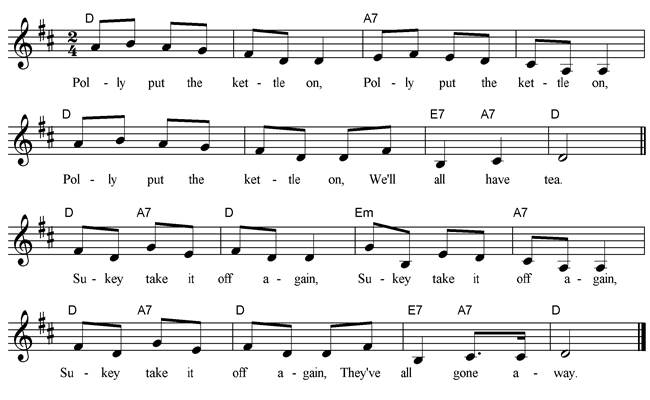
It’s time for a cup of tea. To find out more about this
rhyme visit: http://en.wikipedia.org/wiki/Polly_Put_the_Kettle_On
|
|
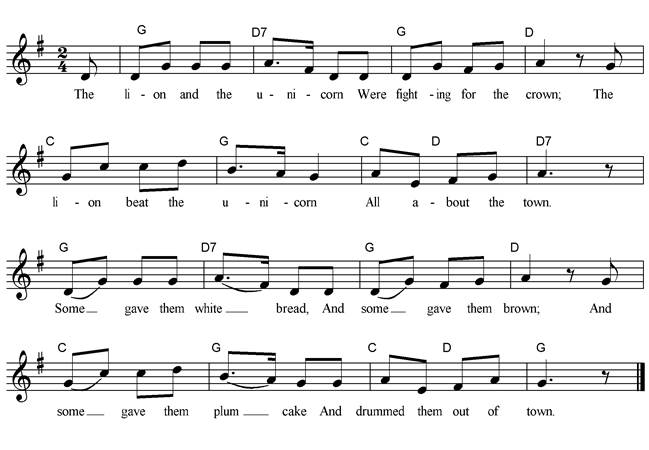
You can see these symbols of
the United Kingdom in many official places. The title refers to two heraldic
icons; the lion represents England and the unicorn Scotland. It has a Roud
number 20170 Find out more about the origins of this song at: http://en.wikipedia.org/wiki/The_Lion_and_the_Unicorn
|
|
Another nursery
rhyme that has likely political origins; in this case the agreement between
England and Scotland to ‘live together’ at the time of Charles 1. See::http://en.wikipedia.org/wiki/There_Was_a_Crooked_Man. The second two verses are
written by Dany Rosevear. |

|
There
was a crooked man, and he walked a crooked mile, He found
a crooked sixpence upon a crooked stile; He bought
a crooked cat, which caught a crooked mouse, And they
all lived together in a little crooked house. Now that crooked little house
had a crooked little door, With crooked little windows and
a crooked little floor. And on the crooked mantel sat a
crooked little clock. That kept them all awake with
its ticking and its tock. So the crooked little man with a
crooked little hop, Took his crooked sixpence to the
baker’s crooked shop; Then he stuffed the crooked
clock with brown crooked bread, And now they all sleep soundly
in their crooked little beds. |
|
A less familiar nursery
rhyme.
|
|
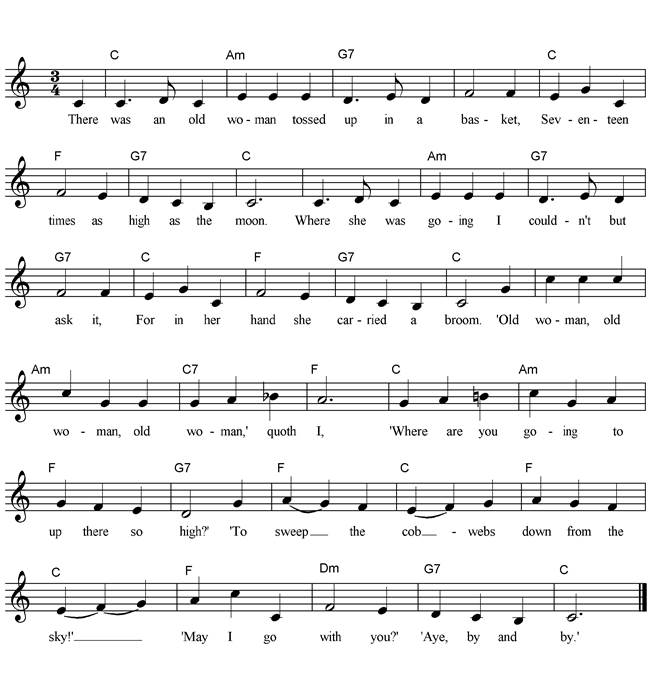
This nursery rhyme is sung to the tune of Lilliburlero.
Purcell used it in his music. Many variations on the lyrics can be found
including ‘Wither, o wither, o wither so high’. The version below is as I
remember it as a child in the 1950s. |
|
There was an old woman tossed up in a basket, Seventeen times as high as the moon. Where she was going, I couldn’t but ask it, For in her hand she carried a broom. ‘Old woman, old woman, old woman,’ quoth I, ‘Where are you going to up there so high?’ ‘To sweep the cobwebs down from the sky!’ ‘May I go with you?’ ‘Aye, by and by.’ |
|
This is the House that Jack
built O
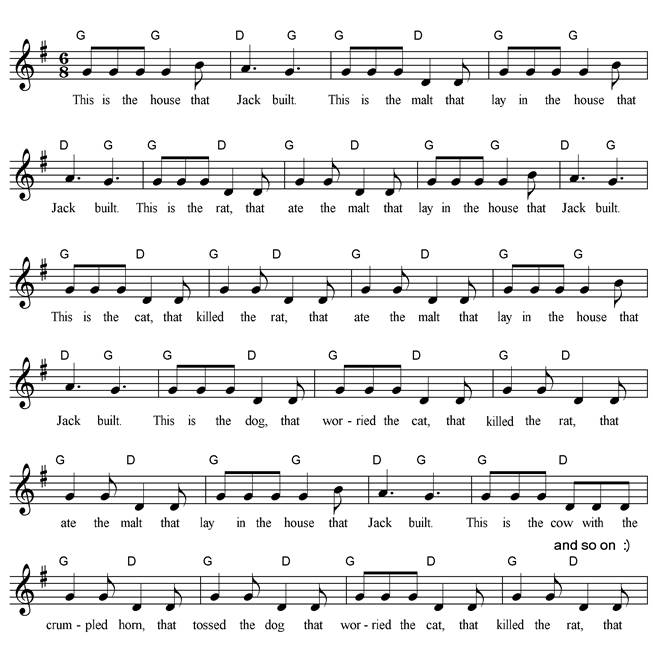
I first came across this
nursery rhyme in 1950 as a four year old in a Ladybird book. It helped me to
learn to read!
|
|
There are many variants of
this nursery rhyme, you can find some at: http://www.mothergooseclub.com/rhymes_parent.php?id=162
|
|
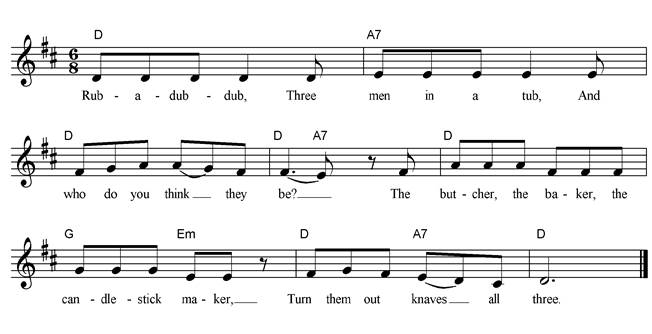
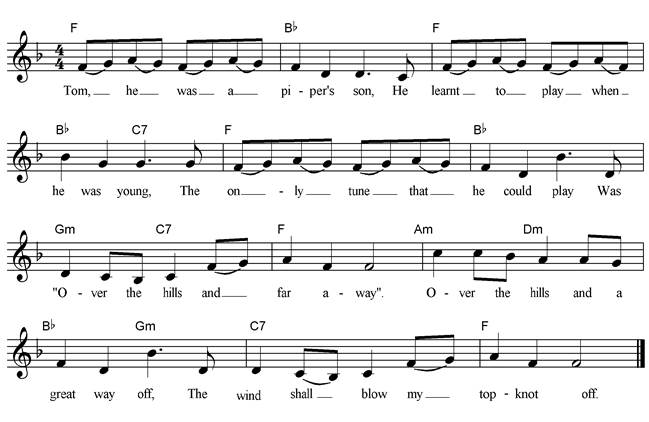
This nursery rhyme began as
a recruiting song designed to gain volunteers for the Duke of Marlborough’s
campaign in 1705 To find out more visit: http://en.wikipedia.org/wiki/Tom,_Tom,_the_Piper's_Son
.
Tom,
he was a piper's son, He
learned to play when he was young; The
only tune that he could play Was
"Over the hills and far away". Over
the hills and a great way off, The
wind shall blow my top-knot off. Tom
with his pipe made such a noise, That
he pleased both the girls and boys, They
all stopped to hear him play "Over
the hills and far away." Tom
played his pipe with such good skill, That
those who heard him couldn’t keep still; As
soon as he played they began to dance, Even
the pigs on their hind legs pranced. Dolly
was milking her cow one day, Tom
took his pipe and began to play; So
Doll and the cow danced ‘The Cheshire round’, Till
the pail was broke and the milk ran on the ground. He
met old Dame Trot with a basket of eggs, Tom
used his pipe and she used her legs. She
danced about and the eggs all broke; Dame
Trot did fret and he laughed at the joke. |
|
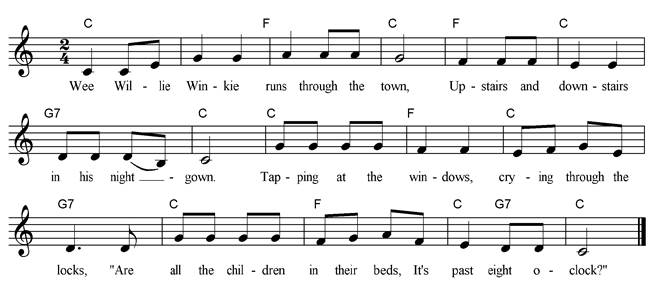
Wee Willie Winkie always
makes you think of bedtime rather like the sandman. It is a Scottish nursery
rhyme by William Miller that became popular all over the English speaking
world. You can find the Scottish words at: http://en.wikipedia.org/wiki/Wee_Willie_Winkie There also seems to be two distinct tunes but the
one below I learnt as a child.
|
Return to the ‘Singing games for children’ home
page